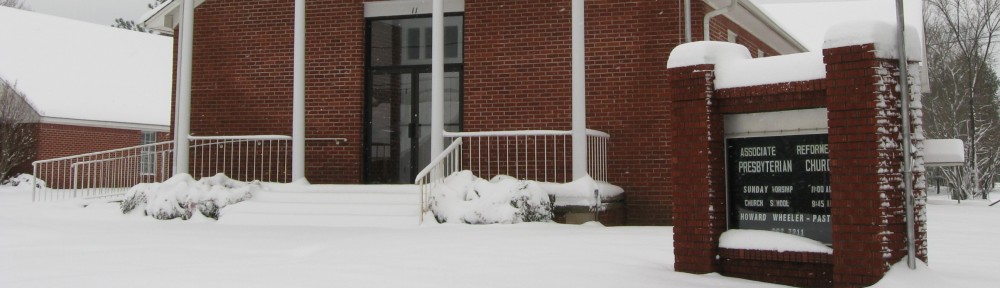
The Pottsville Associate Reformed Church is hosting a Bonfire and Fall Party, Friday, October 20, 2017. We will get started at 6:00pm at The Manse. The Church will provide caramel apples, popcorn, and cider and each family will bring a favorite Fall food or dessert. So break out your instruments! Dust off your vocal cords! Bring all your friends and family and join us for a night of fire, music, games, food and fun! Click here for directions or email us at pottsvillearp@gmail.com for more info.
Category Archives: Uncategorized
Tippecanoe and Tyler Too
While old campaign slogans may be catchy and the memorabilia that immortalized them collectable, the issues they expressed are hardly relevant or even discernible in our day. As we approach the 500th anniversary of the Reformation on October 31, 2017, our social media feeds will be burgeoning with memes and sermon series announcements related to the Five Solas, or Reformation era slogans, expressing the central concerns of the Protestant Reformers. These slogans are:
- Sola Scriptura, By Scripture alone,
- Sola Gratia, By Grace alone,
- Sola Fide, By Faith alone,
- Solus Christus, By Christ alone,
- Soli Deo Gloria, For God’s Glory alone.
As a Reformed Church our identity and our name is connected explicitly to a Sixteenth Century historical movement in Western European History, while our faith and practice is staunchly defined and directed by a book that has not been updated in almost two thousand years.
Are we not a living, breathing anachronism? Are we not irrelevant to culture and a world that has advanced and moved on from the historical context into which we were born? Does the Reformation still matter? Do the Five Solas have any more relevance for our lives today than “Tippecanoe and Tyler Too?” Or are we just worshiping and practicing our own outdated style in a world that is moving on without us? These are weighty questions which we need to ask and answer as we consider “who” and “what” we are as a Reformed Church in the Twenty-First Century.
Join us this Lord’s Day, October 8, for worship at Pottsville Associate Reformed Presbyterian Church as we consider the question, “Why Does Sola Scriptura Still Matter?” For directions click here. We look forward to seeing you.
Apathy
Scientists announced today that they have discovered a cure for apathy. However, they claim no one has shown the slightest interest in it. George Carlin
Apathy can be deadly. Apathy takes us off our guard and makes us vulnerable to accident or attack. As soon as we overestimate our ability or underestimate our opposition, trouble begins to brew. The scripture is filled with admonitions against apathy both in regard to physical life and spiritual life.
The giant, Goliath, was apathetic. He overestimated his ability and underestimated his opposition. He thought he was facing a mere shepherd boy in David, but he was dead wrong. The Philistine said to David,
“Come to me, and I will give your flesh to the birds of the air and to the beasts of the field.” Then David said to the Philistine, “You come to me with a sword and with a spear and with a javelin, but I come to you in the name of the Lord of hosts, the God of the armies of Israel, whom you have defied. This day the Lord will deliver you into my hand, and I will strike you down…” 1 Samuel 17:44-46
To be apathetic toward God’s word, power and judgment is a deadly business. In His Letters to the Seven Churches in Asia in Revelation 2 and 3, the risen Christ rebuked the Laodicean church, not for gross immorality or doctrinal compromise, but for it’s apathy.
“‘I know your works: you are neither cold nor hot. Would that you were either cold or hot! So, because you are lukewarm, and neither hot nor cold, I will spit you out of my mouth.” Revelation 3:15-16
Are you apathetic toward God? Is your spiritual life cold and dry? Are you unconcerned about the condition of your soul? This is the sorry picture that confronts us in Genesis 19. As the men of Sodom stand upon the eve of judgment, their only thought is to gratify their selfish and evil desires. Even when it is obvious that judgment is upon them, they still plod forward in sin. Their apathy proved deadly.
Join us this Lord’s Day, October 1, for worship at Pottsville Associate Reformed Presbyterian Church as we examine Genesis 19 and consider our own responsiveness to the realities of God’s judgment and discipline in our lives. For directions click here. We look forward to seeing you.
Teach Us to Pray
In Reformed Churches, teaching on prayer is often guided by confessional expositions of the Lord’s Prayer. Luke’s gospel tells us that Jesus teaching on the Lord’s Prayer was a triggered by the disciples’ request, “Lord, teach us to pray.” They asked not merely for a formula, but for a lifestyle. John Calvin commented in regard to the prayer life exhibited in the Psalms.
I have been accustomed to call this book, I think not inappropriately, “An Anatomy of all the Parts of the Soul;” for there is not an emotion of which any one can be conscious that is not here represented as in a mirror. Or rather, the Holy Spirit has here drawn to the life all the griefs, sorrows, fears, doubts, hopes, cares, perplexities, in short, all the distracting emotions with which the minds of men are wont to be agitated.
Paul, commenting on the prayer life of Epaphras, pastor of the church at Colossae, noted that he was characterized by “wrestling in prayer on behalf of [his congregation].”
Prayer is no mere organ recital or a Letter to the Santa. Prayer unfolds and lays bare the anatomy of our soul before our Heavenly Father, Creator and Lord. It is more akin to wrestling than a polite beginning to a meal or ending of a meeting. What does prayer look like in your life?
Join us this Lord’s Day, September 24, for worship at Pottsville Associate Reformed Presbyterian Church as we examine Genesis 18:16-33 and consider some valuable lessons regarding prayer from the life of Abraham as he wrestles with God in prayer over the fate of Sodom and Gomorrah. For directions click here. We look forward to seeing you.
Laughter
What makes you laugh? While on the surface the answer seems obvious, the science of laughter is actually quite complex. Certainly humor can trigger laughter, but so can nervousness or simply the laughter of others. The area of the brain that controls laughter also controls breathing and many of our involuntary control mechanisms.
We often laugh in response to things that don’t fit with what we think should happen. Our experience often functions as a predictive grid for anticipating what will happen in any given situation. When we expect one thing and then something else happens — when our scripts are broken in a non-threatening way, laughter is a common response.
Sarah had heard God’s word of promise, regarding a son, for a quarter of a century. But her experience did not seem to square with God’s promises. All of a sudden, when all possibility of fulfillment through her own womb or that of another is past, angelic messengers arrive with a precipitous birth announcement. What is her response? Laughter.
Join us this Lord’s Day, September 17, for worship at Pottsville Associate Reformed Presbyterian Church as we examine Genesis 18:1-16 and consider how God graciously confronts us when are struggling with unbelief and with the apparent disconnects between God’s Word and our expectations. For directions click here. We look forward to seeing you.
Signage
Effective signage is an art, but by observing most road signs, it is apparently a lost art. An effective sign is readable from a distance, clear but concise, and accurately represents the destination to which it points. Effective signs give comfort to the pilgrim on his journey, assuring him both of the reality of the destination and confidence that he is on the right path. Confusing or obsolete signs, however, cause confusion, anxiety, and circuitous routes to various dead ends.
No pilgrimage has more need of effective signage than the journey of faith. Perhaps as a child you learned the Bible verse, “Your word is a lamp to my feet and a light to my path.” (Psalm 119:105) The Bible encourages us in our faith journey, instructing us
“Stand by the roads, and look, and ask for the ancient paths, where the good way is; and walk in it, and find rest for your souls.” Jeremiah 6:16
Like Jesus’ disciple Thomas, however, we are apt to cry out, “Lord, we do not know where you are going. How can we know the way?” Jesus’ answer to him was “I am the way, the truth and the life.” Yet, the Lord knows that we need effective signage to follow the One who is The Way. He graciously gives signs and seals of His grace to comfort and assure us on our journey. Some Christians call these signs and seals, sacraments and others refer to them as ordinances.
Though in different times, God has given different signs, the path and the destination remain unchanged. For this reason it is important for us to understand the meaning of older signs in order to follow the newer signs that God has given. The Old Testament sign of circumcision is one of these signs that was “obsolete and passing away” in the New Testament. Yet both the Old Testament and the New Testament use it to direct us to critical and timeless realities of our faith. For this reason it is important to understand why God posted this covenant sign and what sign replaces it today.
Join us this Lord’s Day, September 10, for worship at Pottsville Associate Reformed Presbyterian Church as we examine Genesis 17 and consider God’s institution of the sign and seal of circumcision to direct, strengthen and affirm faith in Christ. For directions click here. We look forward to seeing you.
Contentment or Complacency?
The Merriam-Webster Dictionary defines complacency as “self-satisfaction especially when accompanied by unawareness of actual dangers or deficiencies.” On the surface it is easy to confuse complacency with contentment in our spiritual lives. We are encouraged in Philippians 4:12-13 to learn contentment, not based on our circumstances, but on Christ’s sufficiency. Yet, Psalm 36:1-2 warns us that it is those out of fellowship with the Lord who never have concern about their spiritual growth or condition.
Even mighty men of faith struggle to distinguish contentment from complacency in their spiritual lives. John Calvin comments regarding Abraham in Genesis 17:1.
“The want of offspring had previously excited him to constant prayers and sighings; for the promise of God was so fixed in his mind, that he was ardently carried forward to seek its fulfillment. And now, falsely supposing that he had obtained his wish, he is led away by the presence of his son according to the flesh, from the expectation of a spiritual seed.”
Had Abraham become content with what God had not promised and so become complacent in his faith? How often is this a struggle for us?
Join us this Lord’s Day, September 3, for worship at Pottsville Associate Reformed Presbyterian Church as we examine Genesis 17 and consider God’s grace kindness toward us, even when our faith is languid and complacent. For directions click here. We look forward to seeing you.
Waiting
The Battle of Bunker Hill was a sobering moment in our history. Though technically a British victory, it came at a high cost. The untested Colonial militia held off the frontal onslaught of Howe’s British seasoned regulars and made them pay dearly before the defender’s lines splintered and broke. Legend attributes the order, “don’t shoot until you see the whites of their eyes,” to one of the Colonial officers. Painfully aware of their low ammunition and lack of bayonets, the colonists calmly awaited the shock of battle, drawing the British into to close combat before firing. Can you imagine the intensity of that moment? How hard it is to wait. We prefer to engage our battles at a comfortable distance.
What is true in warfare is equally true in the combat of faith. We like to exercise our faith at a safe distance, outside of conflict and trial and uncertainty. But faith tested is faith strengthened. In scripture, Abram’s faith is repeatedly tested. Through famine, through prosperity, through barrenness and through birth, God tests and grows Abram’s faith. Waiting is one of the ways God tested Abram. Waiting can be a severe test of our faith. Consider how many times the scripture instruct us to wait before the Lord. Yet we often grow impatient. Impatience with the means or timing of God’s promises tempts us to use accelerants of our own devising. But accelerants are explosive and deadly.
Join us this Lord’s Day, August 27, for worship at Pottsville Associate Reformed Presbyterian Church as we examine the testing of Abraham’s faith from Genesis 16 and consider the temptations we face when God seems silent. For directions click here. We look forward to seeing you.
Warp and Woof
Mathematics has axioms – presuppositions, accepted without proof — which form the basis for all subsequent mathematical proofs. Likewise, Christianity demands certain presuppositions. As a revealed religion, Christianity’s presuppositions, its axioms, must be accepted on faith. But this often seems to be an intellectual cop-out.
An appeal to faith in a recent conversation with a friend and skeptic brought charges of “philosophical laziness.” “No so,” I answered, but I also had to admit that the exercise of faith is not binary. Faith is not either on or off, absolute or absent, and not black and white. Faith has contours. It has a warp and woof which creates contours in quality, character, and shading. Faith has axioms, but it also demands proofs. It has doubts but it asks questions. It waxes and wanes, but does not fail. It is a gift, but it must be exercised and grow directed by the Spirit through a process of sanctification.
Abraham is the paradigmatic man of faith in Scripture and Genesis 15:6 is the core profession of his faith. But even in this passage we see the contours of Abraham’s faith as it is received and exercised.
Join us this Lord’s Day, August 20, for worship at Pottsville Associate Reformed Presbyterian Church as we examine the faith of Abraham from Genesis 15 and consider the contours of our own faith. For directions click here. We look forward to seeing you.
Rescue Operation
Jesus said that He “came to seek and to save that which is lost.” He came to proclaim liberty to the captives. He rescues for His Father, those of his own who have been enslaved by their rebellion against God and their own self-destructive identity and choices. As Jesus’ followers, we are to go and do likewise. What are you doing to be used by Jesus to seek and to save those in your sphere of influence who are lost? Beware, it is a messy calling.
Abram and Lot had a complicated relationship. It was marked by disagreement and discord. When Abram sought to bring harmony, Lot acted self-centeredly and disrespectfully. It would have been easy for Abram to turn Lot over to all the consequences of his actions and attitudes, but that is not what we see. Abram is characterized by interceding for Lot, for seeking his good and God’s grace in his life. Like his Savior, Abram is a man committed to rescuing his own from the effects of his ungodly choices.
Join us this Lord’s Day, August 13, for worship at Pottsville Associate Reformed Presbyterian Church as we examine the account of Abraham and Lot from Genesis 14 and consider how we are to “seek and to save that which is lost.” For directions click here. We look forward to seeing you.