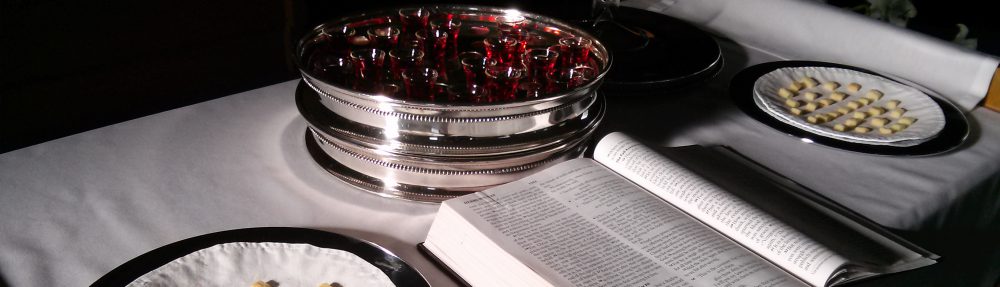
Beauty is easy to recognize but hard to express. Often it is seen best in art, architecture, literature, & ceremony. When these media converge, the result is breathtaking. Christian worship is such a convergence, showing us the amazing beauty of grace. Join us as we examine Leviticus 8 and consider the beauty of Christ, of forgiveness, and of fellowship expressed in and through Christian worship.
Tag Archives: Family Integrated Church
04/07/2024 | “No Shadow of Turning” | James 1, Matthew 24
For some the eclipse points to a faithful God whose love, presence, and promises are never eclipsed by sin or circumstance. While for others, the darkened sun is a fearful sign of uncertainty about where they stand with their creator. If you would like to know more about this God who never changes and His Son whose love is never eclipsed, listen to “No Shadow of Turning.”
03/31/2024 | “Skeptics Welcome” | John 20:1-31
The empty tomb is a sign reading “Skeptics Welcome.” The accounts of the crucifixion, death and burial of Jesus, and the empty tomb provide a trove of evidence explainable only by Jesus’ resurrection. The stone was moved to let skeptics in not to let Jesus out. Join us this Lord’s Day as we examine the account of the empty tomb from John 20 and consider an invitation to skeptics to examine and believe in the resurrection of Jesus.
03/24/2024 | “Behold Your King!” | John 19:1-37
The people rage, the rulers smirk, and Satan gloats. Yet, what appeared Satan’s hour of supreme triumph was, in truth, the moment of his complete and utter defeat. Pilate’s actions were all wrong, but his words were spot on. “Behold Your King!” Join us as we examine John 19:1-37 and consider King Jesus, powerfully declared, shockingly enthroned and utterly victorious.
OJT
“Satan hates pens,” Luther declared. Why? Because as one pastor aptly observed, “our books may come to be seen where ourselves shall never be heard. These may preach where the author cannot, and (which is more) when he is not.” The written word transforms the temporal experience, knowledge, wisdom, and, yes, folly of temporal men into the realm of the transcendent.
Written words are like treasured inheritance from forefathers we never knew. They have the power to jumpstart wisdom not learned from the School of Hard Knocks. They remind us of the Solomon’s maxim that “What has been is what will be, and what has been done is what will be done, and there is nothing new under the sun.” And as we learned in grade-school history, “those who cannot remember the past are condemned to repeat it.”
But unless those words are both heard and heeded, they are an unclaimed inheritance. They must be put into practice. The accumulation of knowledge and, indeed books, is of little value if the words are not worked into and then worked out in our lives. Both book-learning and application are required. As Solomon noted, “of the making of books there is no end, and much study is a weariness of the flesh.” Or as Violet Biggs quipped to George Bailey, “Georgie, don’t you ever get tired of just reading about things?”
And if this is true of written words, how much truer is it of The Word. As Jesus explained in the Parable of the Sower, “those that were sown on the good soil are the ones who hear the word and accept it and bear fruit, thirtyfold and sixtyfold and a hundredfold.”
Jesus’ brother, James put it more bluntly.
But be doers of the word, and not hearers only, deceiving yourselves. For if anyone is a hearer of the word and not a doer, he is like a man who looks intently at his natural face in a mirror. For he looks at himself and goes away and at once forgets what he was like. But the one who looks into the perfect law, the law of liberty, and perseveres, being no hearer who forgets but a doer who acts, he will be blessed in his doing. James 1:22-25
Then he famously summarized, “faith without works is dead.” Two things are needed. Reading the Word. And heeding the Word. It must be worked in then worked out. And so, in Leviticus, which is almost entirely the Lord’s words spoken directly to the people, there is instruction for on-the-job-training. Leviticus 8-10 is one of the few narrative portions of this priestly handbook. And in it, the Lord instructs Moses to walk the priests and the people through what He has taught them.
Specifically, these chapters focus on teaching the people to worship God as He commanded. They had been steeped in idolatry for over four hundred years. And only a short time ago, despite hearing the voice of God and seeing his glory above them, they wallowed in infamous idolatry. And at the end of this passage, we see again how deadly innovation in worship can be.
The people needed God’s instruction about worship, but they also needed to be shown how to apply it. If they are to live Coram Deo, “before the face of God,” and quite literally in his presence, they must understand that worship is the principal expression of that relationship. Just as it is for us. The trajectory of worship is the trajectory of your relationship to a holy, righteous, sovereign, gracious, merciful God. Not just on the Lord’s Day, but every day.
And while we learn much from written instruction, we learn best by doing. There is no substitute for on-the-job training. And so, for one whole week, Moses takes the priests through the ordination process, a process designed to teach them exactly how to perform and administer every sacrifice God had commanded. And once they are trained and ready, God instructs Moses to walk the people through Worship 101.
So Leviticus 9 reveals the trajectory for worship. Worship has a progression, a pattern. This trajectory is the same for our corporate, family, and private worship. Indeed, it is the pattern for every aspect of our relationship with God. And our worship today follows this same pattern of covenant renewal outlined in Leviticus 9. It begins with God’s call. Responds with confession. Draws near through consecration by the ministry of the Word. Reaches a high point in communion. And concludes with a benediction and commission.
The Lord introduces this pattern for worship and life with a great promise, that in worship “the glory of the Lord may appear to [us].” Is your worship glorious? Or tedious? Does your worship inform the pattern for your life in Christ? Or is it just a Sunday thing? Join us as we examine Leviticus 9 and discover the trajectory of worship God has given us. We meet on the square in Pottsville, Arkansas right next to historic Potts’ Inn for worship. Get directions here or contact us for more info. Or join us on Facebook Live @PottsvilleARP or YouTube.
Get the Picture
It has never been easier to snap a good photo. The sophistication of our jankiest smart phones is mind-blowing. Even burner phones have cameras that excel the past century of photographic technology. Anyone and everyone can get ‘the shot.’ Yet artistry is still required to truly get ‘the picture.’ Angle, lighting, and expression are not variables easily solved with better cameras and software. The skilled photographer tells a story and puts the beholder’s feelings, dreams, and aesthetic sensibilities in the frame.
This distinction between a good camera and a good photographer explains why it is hard to get the picture we want. Holiday gatherings illustrate this well. Only my skillful wife can turn our festive family clump into an artful rendering. Left to our own devices, my glasses reflect light, my mouth will be agape, and this or that child will look at anything except the camera. And someone always makes what we call the “cheeeee” face, displaying more teeth than ever necessary for a polite smile. Then, of course, if it is an outside shot, all children are utterly and irrecoverably blinded by the sun for the 30 seconds required for a family portrait.
While beauty is easy to recognize, it is hard to express. And even harder to capture. Often it is best captured and expressed through art, architecture, literature, and ceremony. And when these media converge, the beauty can be quite breathtaking. Christian worship is such a convergence. Art, architecture, literature, and ceremony, all appointed by God and regulated by his command, unveil a transcendent beauty that brings joy, peace, comfort, assurance, and faith. Like springs to thirsty souls, God speaks through each of these means of grace by his Holy Spirit to fill us with awe and wonder. Worship should always be like that.
This is exactly what we see in Leviticus. Though we expect Leviticus to be dry, repetitive, tedious, and obsolete, in it God works in all his appointed media to unveil for us what the Psalmist described as the “splendor of holiness.” The New Testament never lays out for us a ‘Directory of Worship.’ We already have that in the Old. The beauty, trajectory, and also dangers of worship are clearly expressed in Exodus and Leviticus.
And that beauty, trajectory, and danger is the same for us as it was for Israel of old. The significant difference being that the rite, ritual and ceremony of the old all pointed to Christ. As Peter noted, “we have the word of prophesy more fully confirmed.” Though now expressed in different forms because of this, the beauty, trajectory, and danger of worship remain.
Leviticus 8-10 interrupt the ceremonial rules and regulations to offer one of the few narrative passages in Leviticus. Here we encounter the pageantry of the ordination and installation of Aaron and his sons but also find the sad story of Nadab and Abihu’s deadly rebellion. And in the liturgy of the ordination ceremonies, the Lord paints a picture of worship that shows its beauty, trajectory, and danger.
Join us this Lord’s Day as we examine Leviticus 8 and consider the beauty of Christ, of forgiveness, and of fellowship expressed in and through Christian worship. We meet on the square in Pottsville, Arkansas right next to historic Potts’ Inn for worship. Get directions here or contact us for more info. Or join us on Facebook Live @PottsvilleARP or YouTube.
03/17/2024 | “Going to War” | John 18:1-32
Abandonment and injustice are not the last word in Jesus’ arrest, trial and crucifixion. The King is going to war. He lays down his life and takes it up again, destroys the devil’s works and delivers us from darkness’ domain into a beloved Son’s kingdom. Join us as we examine John 18:1-32 and consider King Jesus going to war to subdue us to himself, to rule and defend us, and to restrain and conquer all His and our enemies.
No Shadow of Turning
A total solar eclipse is a rare occurrence. On April 8, 2024, central Arkansas will experience a total eclipse, as the sun will be completely obscured by the moon. Pottsville and Russellville fall along the centerline of the path of totality. Along that trajectory the total eclipse will last for 4 minutes 13 seconds. The eclipse will begin at approximately 12:33 pm CDT and reach totality around 1:50 pm CDT.
Several websites provide good information about the eclipse. Nationaleclipse.com provides comprehensive info about all things related to the eclipse across the thirteen states that lie in the path of totality. And eclipserussellville.com is an excellent local source of information about events and opportunities related to experiencing the eclipse in the Arkansas River Valley.
If you are preparing to join us here in the Arkansas River valley to view the eclipse, it is helpful to be aware of the unusual effects a solar eclipse produces.
- Before the eclipse reaches totality, shadow bands will form on plain-colored surfaces. The wavy lines of light and dark, lined up in parallel rows, will undulate and move rapidly across the ground.
- During the partial phase, a minute or more before and after the eclipse — when the sun looks like a crescent moon — the colors in the landscape will appear saturated and contrast is boosted. Shadows cast through leafy trees, sometimes called anti-shadows, will appear to be hundreds of tiny crescent-shaped shadows because the gaps between leaves act like pinhole cameras.
- During the total eclipse, when it is safe to look at the eclipse with the naked eye, experts say you can expect to see jets and ribbons of light in the corona, the sun’s outer atmosphere, twisting and curling out into the sky.
- As soon as the Moon entirely covers the Sun and causes the sky to completely blacken, the air will instantly chill — perhaps by as much as 20 degrees Fahrenheit.
- Animals will become confused and nocturnal animals may awaken and become active. Bats may fly around thinking it is night. Birds may go to roost. Crickets or cicadas may begin to chirp. Insects may come out during moments when the sky darkens.
- If the land is flat for miles around your location or you are on a mountain top, you will be able to see the darkest part of the Moon’s shadow (called the umbra) racing across the ground towards you just before totality and away from you afterwards.
- During totality, brighter stars, such as Regulus, will be visible, as well as all of the five planets which can be seen with the naked eye: Jupiter, Mercury, Venus, Mars and Saturn. In addition, the “12P/Pons-Brooks” comet will be visible near Jupiter.
Read here for more effects of the eclipse.
A total solar eclipse is truly majestic, inspiring awe in the created order. But even more so, it gives glory to the God who created such a beautiful and predictable universe. The Bible tells us that God created the sun, moon, and stars on the fourth day of creation both to provide light and create the rhythms of time that govern and guide all things.
And God said, “Let there be lights in the expanse of the heavens to separate the day from the night. And let them be for signs and for seasons, and for days and years, and let them be lights in the expanse of the heavens to give light upon the earth.” And it was so. And God made the two great lights—the greater light to rule the day and the lesser light to rule the night—and the stars. And God set them in the expanse of the heavens to give light on the earth, to rule over the day and over the night, and to separate the light from the darkness. And God saw that it was good. And there was evening and there was morning, the fourth day. Genesis 1:14-19
The ancient world depended on the predictability of celestial cycles. Yet the ancients could not predict solar eclipses. To them a darkening and darkened sun was a sign of judgement and unimaginable catastrophe. It seemed to confirm the latent fear of darkened pagan hearts and minds that their gods were capricious and angry – unpredictable and bent on judgment and destruction. Yet we read of the God of the Bible that,
Every good gift and every perfect gift is from above, coming down from the Father of lights, with whom there is no variation or shadow due to change. James 1:17
The word translated shadow is an ancient word which means “eclipse.” The Lord is a God who is constant and kind. He never changes. He is as good as His Word. Consider what the scripture says about God’s promises.
Not one word of all the good promises that the Lord had made to the house of Israel had failed; all came to pass. Joshua 21:45
For all the promises of God find their Yes in [Christ Jesus]. That is why it is through him that we utter our Amen to God for his glory. 2 Corinthians 1:20
The Lord is not slow to fulfill his promise as some count slowness, but is patient toward you, not wishing that any should perish, but that all should reach repentance. 2 Peter 3:9
On April 8, 2024, thousands will gather in the thirteen states that lay in the path of totality to behold something truly spectacular. For many the eclipse will point to the faithfulness of a God whose love, presence, and promises can never be eclipsed by circumstances or sin. While for others, the darkening and darkened sun may represent a fearful sign of uncertainty about where they stand with their creator.
If you would like to know more about this God who never changes and His Son whose love is never eclipsed, then join us in person or via livestream, Sunday, April 7, 2024 at 10:30 am. We meet on the square in Pottsville, Arkansas right next to historic Potts’ Inn for worship. Get directions here or contact us for more info. Or join us on Facebook Live @PottsvilleARP or YouTube.
Skeptics Welcome
We live in an age of flourishing skepticism, particularly when it comes to religion. Science is seen as the new arbiter of absolute truth and the “scientific-method” the only test of the believe-worthiness of any idea. The incredible popularity of thinkers such as Stephen Hawking underscores this flowering of the enlightenment enthronement of human reason.
Hawking, who once quipped that “heaven [and the afterlife] were fairy-stories for people afraid of the dark,” nevertheless frequently left his own pay-grade in the narrow confines of mathematics and observable physics to declare metaphysical absolutes. It was this dimension of his writing and thinking that made him a pop icon.
Many skeptics today view religion, in general, and Christianity, in particular, as afraid of rational inquiry and apologetic challenge. From the view of the secularist, Christianity has circled the wagons, arrogantly assuming the “fairy tales” of the Bible are true while closing its eyes to all reason and evidence. Yet nothing is further from the truth. Real and vibrant Christianity hangs out a shingle that says, “Skeptics Welcome.”
Nowhere is this seen more dramatically than in the Biblical accounts of the resurrection. No point of Christian doctrine has been more thoroughly assaulted by skeptics than the resurrection. Yet every assault strengthens credibility.
When the accounts are critically examined, it seems God took great care to surround the crucifixion, death and burial of Jesus along with the subsequent discovery of the empty tomb with a vast body of evidence which can only be satisfactorily explained by Jesus’ resurrection. In many respects, the empty tomb is a sign that reads “Skeptics Welcome.” The stone was not rolled back to let Jesus out, but to let skeptics in.
Join us this Lord’s Day as we examine the account of the empty tomb from John 20 and consider an invitation to skeptics to examine and believe in the resurrection of Jesus. We meet on the square in Pottsville, right next to historic Potts’ Inn at 10:30 am for worship. Get directions here or contact us for more info. Or join us on Facebook Live @PottsvilleARP or YouTube.
2024 Good Friday Gathering
Join us for a Good Friday Gathering of Songs and Readings, Friday March 29, 2024 at 6:00 pm on the grounds of the Pottsville Associate Reformed Presbyterian Church. We will gather outside around the bonfire for food, fellowship, and a time of songs and readings to observe Good Friday. Bring your favorite Mediterranean finger food or dessert. Click here to get the Readings and Hymns. We look forward to seeing you.

