Is your spiritual life growing, bearing fruit & scattering seed for others? Do you know the Sower’s attentive care & the Seed’s life-giving power? Are you like receptive soil? Or has hardness, fear or distraction prevented you from growing fruitfully? Join us as we examine Mark 4:1-20 and consider the gracious Sower, the life-giving Seed, and the receptive Soil that bring fruitful life.
Tag Archives: Gospel of Mark
Good Hearing
It was certainly not feminine mystique, but NaNaw exuded the mystery of a life, large-lived, unveiled to her grandchildren only in glimpses and curios. She was a woman of fierce intensity. Her soul-piercing gaze could freeze young hearts. She had a “yard-broom” made of long, thin branches, any one of which might in a moment be plucked out as a rod of reproof. But when she smiled, it was like the sun after rain.
Her décor was eclectic. A Japanese watercolor of Mt. Fuji. The ornately carved pump organ with its swirly chair. And especially her trunk, whose collection boasted her grandfather’s powder horn, a torn Confederate dollar, and bundles of cards and letters from my father and my uncles when they were mere boys serving their Uncle Sam at the ends of the world. Though ancient in my estimation, NaNaw was never frail. She was vigorous in everything except her hearing. Though, my mother often remarked that NaNaw couldn’t hear you if you were speaking to her but would hear you clearly from three rooms away if you were speaking about her.
Good hearing depends upon much more than the operational efficiency of our ear drums, middle-ear ossicles, cochlea, and inner ear. It is enhanced by other senses as well as our mindfulness. As anyone who lives near train tracks can tell you, it is easy to filter out routine sounds, no matter how invasive. We tune out and we tune in. When we hear our name in a crowd, we tune in. When we hear our mother tongue in a foreign land, we tune in. But as Charlie Brown’s teacher illustrates, we often tune out when listening to authority or criticism.
Good hearing requires more than sharp ears. It involves choice. And it involves commitment. It demands discernment. It is not limited to the point in time in which communication occurs. It requires preparation before. And reflection afterwards. It must hear both what is auditory and what is not. Consequently, in English we distinguish between listening and hearing.
The Gospel of Mark is the action gospel. King Jesus appears in glory and power. He demolishes the dominion of Satan. He proclaims the coming Kingdom of God. And though Mark often mentions Jesus’ teaching, he does not recount much of it. Only in Mark 4 and Mark 12 is the content of Jesus’ teaching recorded. And in both chapters, we read “and he began to speak to them in parables.” He commands his hearers and us to “Listen!… He who has ears to hear let him hear.” Then warns,
Pay attention to what you hear: with the measure you use, it will be measured to you, and still more will be added to you. For to the one who has, more will be given, and from the one who has not, even what he has will be taken away. -Mark 4:24-25
How good is your hearing? Are you a careful listener? A selective listener? Are you tuning in to God’s Word? Or tuning Him out? What are you choosing to hear? And whose words are you trusting? What measuring cup are you using to scoop God’s Word into the mixture of your life?
Join us this Lord’s Day as we examine Mark 4:21-34 and consider what it looks like to have good hearing. We meet Sundays at 10:30 am on the square in Pottsville, Arkansas right next to historic Potts’ Inn for worship. Get directions here or contact us for more info. Or join us on Facebook Live @PottsvilleARP or YouTube.
Fruitful
To till or not to till? That is the question. But it is not the only question. Is this plant a nitrogen feeder or consumer? What plants grow in together beneficially? What plants should not be allowed to cross-pollinate? And what about pest control? Marigolds or Seven-Dust? And where can the tomatoes go this year?
Making a fruitful garden is more art than science. Or perhaps we should say, more providence than skill. The timing and amount of early spring and late summer rains, the last and first hard freeze, and the median temperatures needed for the tomatoes to ‘set’ are all out of our control. A wise, older woman once counseled that a garden was planted 1/3 for the deer, 1/3 for the pests and 1/3 for you. And, even then, it was still up to the Lord.
The phrase “garden season” is of course a misnomer. Gardening is a year-round endeavor. In late fall you clear last year’s stubble and prepare the ground for the year to come. In winter you map out the crop rotation and purchase seeds. In late winter and early spring, you seed and tend the plants starts, filling every south-facing window. And of course, try to remember when it is time to put in the potatoes. By April the frosts are past, and the garden is in full swing as the sower ploughs in hope of a fruitful harvest and a full pantry and freezer.
Fruitfulness results from the attentive care of the sower, the quality of the seed, the preparation of the soil, and the Lord’s sovereign Providence. As is often the case, agricultural realities are apt analogies for spiritual realities. Jesus’ use of agrarian life to illustrate spiritual life is more than cultural relevance for his contemporary hearers. His teaching is meant just as much for us as for them.
Scripture often compares spiritual life to growing things. Psalm 1 compares the man who heeds God’s word to an everbearing tree planted by streams of water. In John 15, Jesus compares men to either fruitful or unfruitful branches. And goes on to say, “You did not choose me, but I chose you and appointed you that you should go and bear fruit and that your fruit should abide.” And the author of Hebrews, quoting Deuteronomy 29:18, warns us to “See to it that no one fails to obtain the grace of God; that no ‘root of bitterness’ springs up and causes trouble.” Paul speaks of the work of the Holy Spirit in believers as the fruit of the Spirit.
God has made us for fruitful, growing spiritual life. On the day God made man, He “blessed them. And God said to them, ‘Be fruitful and multiply…’” But perhaps no scripture passage speaks more about spiritual fruitfulness than Jesus’ first recorded parable, The Parable of the Sower. All the Synoptic Gospels include it, but in Mark we find both its fullest expression, and an explanation of Jesus’ purpose and method in using parables. And so, it is a parable but also a parable about parables.
Parables are not allegories. They have one central meaning. And it is not necessary to discern a distinct symbolism for every element of the story. One commenter famously noted that parables are “earthly stories with a heavenly meaning.” Commenters have long debated whether the Parable of the Sower is about the Sower, the Seed, or the Soils. Yet these three join together to teach us to live spiritually fruitful lives.
Are you fruitful? Is your spiritual life growing, bearing fruit, and scattering seed for the next generation? Do you know the tender, attentive care of the Sower, the life-giving power of the Seed? Are you like receptive Soil? Or has hardness, or fear, or distraction prevented the seed from growing fruitfully in you?
Join us as we examine Mark 4:1-20 and consider the gracious Sower, the life-giving Seed, and the receptive Soil that bring fruitful life. We meet Sundays at 10:30 am on the square in Pottsville, Arkansas right next to historic Potts’ Inn for worship. Get directions here or contact us for more info. Or join us on Facebook Live @PottsvilleARP or YouTube.
11/03/2024 | “Unforgivable” | Mark 3:20-35
Is all sin eligible for forgiveness? Jesus spoke of the unforgiveable sin of blaspheming the Holy Spirit? But what does this mean? Have we committed this sin? How can we know? Can we recover from it? This weighs heavily on us in the dark of night. Join us as we examine Mark 3:20-35 and consider what Jesus is saying about faith and unbelief in this passage and what it means to blaspheme the Holy Spirit.
10/27/2024 | “On Being Chosen” | Mark 3:7-19
The Kingdom of God is no meritocracy based on skill, prominence, or net worth. Lists of the Twelve in the gospels highlight this vividly. The apostles were uneducated, common men. But because they had been with Jesus, they turned their world upside down. Join us we examine one of these lists in Mark 3:7-19 and consider purposes, plans, and people of God’s choosing.
10/20/2024 | “Making Jesus Angry” | Mark 3:1-6
Jesus got tired and hungry. He was tempted every way we are. And he got angry. Especially when men loved Sabbath rigor over healing a disabled man. Graceless religion is fallen man at his worst, despising God’s love and His Son. And it made Jesus angry. Listen as we examine Mark 3:1-6 and consider what makes Jesus angry.
10/13/2024 | “Getting Rest” | Mark 2:23-28
Nothing steals Sabbath rest like legalism. The men of Jesus’ day turned gracious rest into self-righteous works. When they complained how the Lord of the Sabbath kept the day, he reminded them that the Sabbath was made for man, not man for the Sabbath. Join us as we examine Mark 2:23-28 and consider how we are the think rightly about the Lord’s Day and how we observe it.
10/06/2024 | “Coexist?” | Mark 2:18-22
Love does not “coexist.” It refuses to go along to get along. Love draws lines, makes demands, does not settle for status quo. As Jesus proclaims the gospel, he draws lines, makes demands, challenges the status quo. New wine explodes old wineskins! Join us as we examine Mark 2:18-22 and consider Jesus’ response to demands that the gospel coexist with somber, self-righteous religion.
Unforgivable
Crunched fenders. Irreparably crooked handlebars. And a serious case of road rash. These were the minor consequences of an epic bike crash. Sure, there was the occasional broken arm. But it was something else we truly dreaded. We knew that a bike wreck would inevitably summon our mothers with a first aid remedy formulated by demons.
Mercurochrome was one of many common mercury-based antiseptics in use in the Seventies. It was a bright red liquid fire in a tiny brown bottle. Our mothers would liberally paint it on our open wounds. And whatever pain you felt from the road rash was quickly forgotten when the searing pain of mercurochrome took hold.
Mercurochrome and other drugs containing mercury first came under scrutiny in 1978 as part of the FDA’s general review of over-the-counter antiseptics. While there was no evidence of mass Mercurochrome poisoning, medical literature contained scattered reports of mercury toxicity due to its use. It took another twenty years for the FDA to declare mercurochrome “not generally recognized as safe and effective” and forbid its sale across state lines. Children today have no idea how good they have it with lidocaine and triple-antibiotic ointment.
Despite the toxic things we put on, and in, our bodies, God has made our frame fearfully and wonderfully able to fight all kinds of disease and effect remarkable healing. The healing of a simple wound or cut is nothing short of miraculous. The human body has a truly remarkable ability to heal.
But when wounds do not heal, they may become septic and deadly. And this is true of other types of wounds we receive. When emotional and spiritual wounds go unhealed, they become septic to our heart, mind, and spirit. And no spiritual wound is more toxic than unforgiveness. The author of Hebrews warns us.
See to it that no one fails to obtain the grace of God; that no “root of bitterness” springs up and causes trouble, and by it many become defiled. Hebrews 12:15.
Grace and the bitterness of unforgiveness are antithetical. The biblical word for forgiveness means to “send away” or “release.” Linguists point out that the ancient words we translate ‘forgiveness’ are connected to untying a knot. And indeed, when we are unforgiving or unforgiven, we are tied in knots. Only grace can cut through the Gordian knot of unforgiveness and affect deep healing.
Psalm 130 speaks of “plenteous redemption.” Leviticus 16:30 promises, “For on this day shall atonement be made for you to cleanse you. You shall be clean before the Lord from all your sins.” The OT Prophets speak of God casting “all [our] sins behind his back” and “into the sea of forgetfulness.” Separating us from our sin as far as east and west.
Likewise, the New Testament tells us that Jesus came “to give knowledge of salvation to his people in the forgiveness of their sins.” And Paul writes, “In him we have redemption through his blood, the forgiveness of our trespasses, according to the riches of his grace.”
And in Mark 3, in response to men who were enemies of grace, Jesus makes a truly amazing statement. “Truly, I say to you, all sins will be forgiven the children of man, and whatever blasphemies they utter.” Matthew’s parallel account even adds, “And whoever speaks a word against the Son of Man will be forgiven.” This is outrageous grace. This gives even the most grievous sinner hope. Through repentance and faith, none of our sins form an impenetrable barrier to God’s love!
But this outrageous grace is immediately contrasted with stunning warning about unbelief. What follows is unarguably the most frightening passage in the Bible. “But whoever blasphemes against the Holy Spirit never has forgiveness but is guilty of an eternal sin.”
What exactly is this unpardonable, unforgiveable sin? What does it mean to blaspheme the Holy Spirit? And more to the point have you committed the “sin unto death” from which there is no hope of grace, mercy, or salvation but only the wrath and curse of God? Without a doubt, this verse weighs heavily on us in the dark of night.
Join us as we examine Mark 3:20-35 and consider what Jesus is saying about faith and unbelief in this passage and what it means to blaspheme the Holy Spirit. We meet Sundays at 10:30 am on the square in Pottsville, Arkansas right next to historic Potts’ Inn for worship. Get directions here or contact us for more info. Or join us on Facebook Live @PottsvilleARP or YouTube.
On Being Chosen
I had a strong arm. But I was a big target. And it was that which seriously reduced my capital as a teammate. Elementary school dodgeball was a hotbed of competition and controversy. No one wanted to waste their pick on an easy target. And so, I waited. And I waited. Until the process of elimination saddled one hapless team with me as their last round draft pick.
I loved school, but recess was not my strong suit. The Presidential Fitness Test and choosing teams were a definite low ebb in my institutional experience. The order of selection was predictable. Tony Fulcher and Roy Daffron were always first. And I was often, if not always, last. I sometimes thought that if the teams could have opted out of the process of elimination, they would have when it came to me. Perhaps you know the angst of choosing teams.
But as with most things in God’s grace-based economy, last things are first things. And unprofitable ones are chosen ones. Incapable servants are made competent and do remarkable things. It is the theme of the Bible that those unworthy and unlikely to ever be chosen are elected by the free grace of God alone and empowered to turn the world upside down.
The Apostle Paul wrote half the New Testament, planted unknown numbers of churches, was responsible for explosive kingdom expansion and yet he writes.
Such is the confidence that we have through Christ toward God. Not that we are sufficient in ourselves to claim anything as coming from us, but our sufficiency is from God, who has made us sufficient to be ministers of a new covenant. -2 Corinthians 3:4-6
God chose an entire nation to be His treasured people, yet he reminds them.
For you are a people holy to the Lord your God. The Lord your God has chosen you to be a people for his treasured possession, out of all the peoples who are on the face of the earth. It was not because you were more in number than any other people that the Lord set his love on you and chose you, for you were the fewest of all peoples, but it is because the Lord loves you. -Deuteronomy 7:6-8
It is God who “arranges the members in the body, each one of them, as he [chooses].” The body of Christ is not a meritocracy based on skill, prominence, or net worth. Despite what we think, these have no power to expand the kingdom of God. The New Testament reminds us that “God chose what is foolish in the world to shame the wise; God chose what is weak in the world to shame the strong.”
Nowhere is this dynamic more on display than in Jesus’ selection of the Twelve in Mark 3. None of those men applied for the position of apostle or submitted to tryouts, auditions, or examinations. Jesus made the choices, choosing those whom he desired. And the list of the Twelve is like a highlighter, underscoring that they were “uneducated, common men,” often very dull, whose only qualification was that they had been with Jesus.
Mark 3:7-19 gives a vivid picture of the crushing demands of following Christ and of God’s grace in choosing and sending us to meet those demands. This passage unfolds God’s purpose in choosing us, his plan for our calling, and an important portrait of the people God chooses and uses.
Join us as we examine Mark 3:7-19 and consider purposes, plans, and people of God’s choosing. We meet Sundays at 10:30 am on the square in Pottsville, Arkansas right next to historic Potts’ Inn for worship. Get directions here or contact us for more info. Or join us on Facebook Live @PottsvilleARP or YouTube.
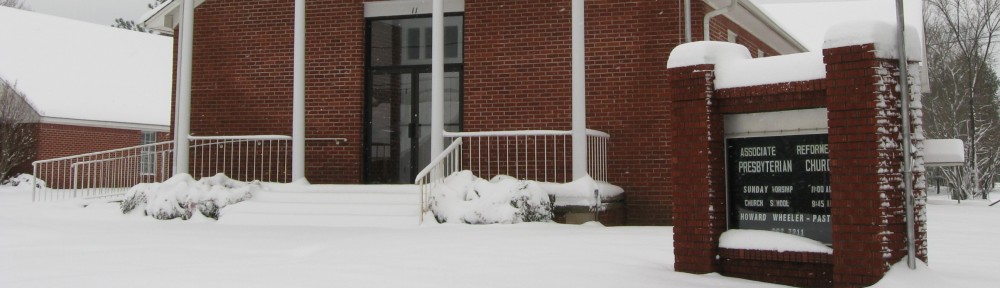
 Pottsville Associate Reformed Presbyterian Church