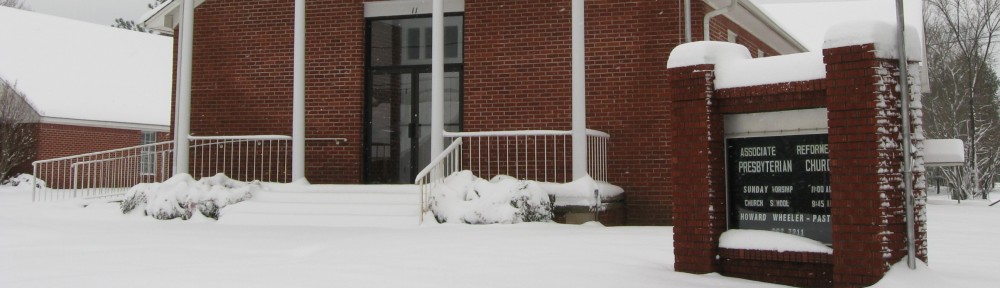
The Pottsville Associate Reformed Church is hosting a Bonfire and Psalm/Hymn Sing, Saturday, May 19, 2018. We will get started at 6:00pm at The Manse. The Church will provide drinks and each family will bring a favorite Middle-Eastern themed appetizer, entree or dessert. Bring your friends and family and join us for a night of psalms, hymns and spiritual songs! Click here for directions or email us at pottsvillearp@gmail.com for more info.
Tag Archives: Pottsville
Bonfire and Hymn Sing
The Pottsville Associate Reformed Church is hosting a Bonfire and Psalm/Hymn Sing, Friday, April 6, 2018. We will get started at 6:00pm at The Manse. The Church will provide drinks and each family will bring a favorite Middle-Eastern themed appetizer, entree or dessert. Bring your friends and family and join us for a night of psalms, hymns and spiritual songs! Click here for directions or email us at pottsvillearp@gmail.com for more info.
The God Who Sees
Recently our Congress extended permissions for the NSA to continue to dumpster dive in the flotsam and jetsam of your digital wake. For another six years, so long as they happen to be hunting foreign terrorists, our government can keep a benevolent eye on us through the cyber tracks we leave everywhere in an ever-broadening desire to be connected.
Our pocket-palantirs are ever listening, watching and reporting. In The Lord of the Rings, Tolkien unwittingly prophesied the doubled-edged benefit of smart phones when he conceived of the Palantir. The Palantir were seeing stones that let the characters in Tolkien’s world see and communicate with one another across time and space. They also revealed the potential futures of those peering into them. Sounds great, except that anyone looking into a Palantir could be seen by anyone possessing another Palantir, especially Sauron with his “all-seeing” eye. Magic rings and Palantir are tempting productivity tools, but remember there is an “all-seeing” eye.
Many of my friends have tape on their smart phone camera, keep wifi and mobile data off, and never enable GPS because of concern that their pocket-palantir makes them seeable by an ambiguously benevolent higher power. But this is not a new idea in the history of the world, just a different tool and new set of players. Men have always had concern over whether they are being watched. Jesus noted that men prefer darkness to light so that their deeds may remain hidden. Yet the scripture notes that even darkness is as light to God and that the Lord sees everything, down even to the deepest thoughts and intents of the hearts.
The Nazca Indians of South America sensed this, even in their spiritual darkness, and constructed mammoth images on the desert floor to please the gods above whom they believed to be angry because of the lives of men. Men throughout history have distressed over an awareness that the God Who Is, is a God Who Sees. The Psalms speaks of those who try repress the knowledge of God’s omniscience through idolatry and atheism. Yet, this thing which men’s darkened hearts fear, is their greatest hope. For the God who sees is the God who saves. The God who sees is the God who loves the loveless and relieves the afflicted in their affliction.
Genesis 29 is a complicated story of an ancient family dealing with the whole cadre of modern sins. Jacob deceives and is deceived, faces drama and jealousy, plays favorites and shirks his obligations and labors under caustic relations with in-laws. What hope is there for such a family? What hope is there for our complicated families? Buried in this passage is the sad tale of Leah, the unloved wife and woman. Her father trundled her off to Jacob to defraud him out of seven additional years of labor. Her new husband despised her. Her wedding bed was shared with her sister. She was the contempt of her husband, father and sister – but not of the Lord who Sees. He saw her in her affliction. He saw that she was not loved. He loved her and gave her the gift of children, whose love would fill up her empty spaces.
Join us for worship this Lord’s Day, March 11, at Pottsville Associate Reformed Presbyterian Church as we examine the story of Leah in Genesis 29 and consider how God, who sees us for what and who we are, is the God who loves us with steadfast and redemptive love. Click here for directions. We look forward to seeing you.
A Service of Readings and Songs
“What thou, my Lord, hast suffered was all for sinner’s gain; mine, mine was the transgression, but thine the deadly pain. Lo, here I fall, my Savior! ‘Tis I deserve thy place; look on me with thy favor, vouchsafe to me thy grace” Bernard of Clairvaux
Join us this Good Friday, March 30, 2018 at 7:00pm at Pottsville Associate Presbyterian Church for a Service of Readings and Hymns. For directions, click here. For more information email us at pottsvillearp@gmail.com.
Tippecanoe and Tyler Too
While old campaign slogans may be catchy and the memorabilia that immortalized them collectable, the issues they expressed are hardly relevant or even discernible in our day. As we approach the 500th anniversary of the Reformation on October 31, 2017, our social media feeds will be burgeoning with memes and sermon series announcements related to the Five Solas, or Reformation era slogans, expressing the central concerns of the Protestant Reformers. These slogans are:
- Sola Scriptura, By Scripture alone,
- Sola Gratia, By Grace alone,
- Sola Fide, By Faith alone,
- Solus Christus, By Christ alone,
- Soli Deo Gloria, For God’s Glory alone.
As a Reformed Church our identity and our name is connected explicitly to a Sixteenth Century historical movement in Western European History, while our faith and practice is staunchly defined and directed by a book that has not been updated in almost two thousand years.
Are we not a living, breathing anachronism? Are we not irrelevant to culture and a world that has advanced and moved on from the historical context into which we were born? Does the Reformation still matter? Do the Five Solas have any more relevance for our lives today than “Tippecanoe and Tyler Too?” Or are we just worshiping and practicing our own outdated style in a world that is moving on without us? These are weighty questions which we need to ask and answer as we consider “who” and “what” we are as a Reformed Church in the Twenty-First Century.
Join us this Lord’s Day, October 8, for worship at Pottsville Associate Reformed Presbyterian Church as we consider the question, “Why Does Sola Scriptura Still Matter?” For directions click here. We look forward to seeing you.
Apathy
Scientists announced today that they have discovered a cure for apathy. However, they claim no one has shown the slightest interest in it. George Carlin
Apathy can be deadly. Apathy takes us off our guard and makes us vulnerable to accident or attack. As soon as we overestimate our ability or underestimate our opposition, trouble begins to brew. The scripture is filled with admonitions against apathy both in regard to physical life and spiritual life.
The giant, Goliath, was apathetic. He overestimated his ability and underestimated his opposition. He thought he was facing a mere shepherd boy in David, but he was dead wrong. The Philistine said to David,
“Come to me, and I will give your flesh to the birds of the air and to the beasts of the field.” Then David said to the Philistine, “You come to me with a sword and with a spear and with a javelin, but I come to you in the name of the Lord of hosts, the God of the armies of Israel, whom you have defied. This day the Lord will deliver you into my hand, and I will strike you down…” 1 Samuel 17:44-46
To be apathetic toward God’s word, power and judgment is a deadly business. In His Letters to the Seven Churches in Asia in Revelation 2 and 3, the risen Christ rebuked the Laodicean church, not for gross immorality or doctrinal compromise, but for it’s apathy.
“‘I know your works: you are neither cold nor hot. Would that you were either cold or hot! So, because you are lukewarm, and neither hot nor cold, I will spit you out of my mouth.” Revelation 3:15-16
Are you apathetic toward God? Is your spiritual life cold and dry? Are you unconcerned about the condition of your soul? This is the sorry picture that confronts us in Genesis 19. As the men of Sodom stand upon the eve of judgment, their only thought is to gratify their selfish and evil desires. Even when it is obvious that judgment is upon them, they still plod forward in sin. Their apathy proved deadly.
Join us this Lord’s Day, October 1, for worship at Pottsville Associate Reformed Presbyterian Church as we examine Genesis 19 and consider our own responsiveness to the realities of God’s judgment and discipline in our lives. For directions click here. We look forward to seeing you.
Teach Us to Pray
In Reformed Churches, teaching on prayer is often guided by confessional expositions of the Lord’s Prayer. Luke’s gospel tells us that Jesus teaching on the Lord’s Prayer was a triggered by the disciples’ request, “Lord, teach us to pray.” They asked not merely for a formula, but for a lifestyle. John Calvin commented in regard to the prayer life exhibited in the Psalms.
I have been accustomed to call this book, I think not inappropriately, “An Anatomy of all the Parts of the Soul;” for there is not an emotion of which any one can be conscious that is not here represented as in a mirror. Or rather, the Holy Spirit has here drawn to the life all the griefs, sorrows, fears, doubts, hopes, cares, perplexities, in short, all the distracting emotions with which the minds of men are wont to be agitated.
Paul, commenting on the prayer life of Epaphras, pastor of the church at Colossae, noted that he was characterized by “wrestling in prayer on behalf of [his congregation].”
Prayer is no mere organ recital or a Letter to the Santa. Prayer unfolds and lays bare the anatomy of our soul before our Heavenly Father, Creator and Lord. It is more akin to wrestling than a polite beginning to a meal or ending of a meeting. What does prayer look like in your life?
Join us this Lord’s Day, September 24, for worship at Pottsville Associate Reformed Presbyterian Church as we examine Genesis 18:16-33 and consider some valuable lessons regarding prayer from the life of Abraham as he wrestles with God in prayer over the fate of Sodom and Gomorrah. For directions click here. We look forward to seeing you.
Laughter
What makes you laugh? While on the surface the answer seems obvious, the science of laughter is actually quite complex. Certainly humor can trigger laughter, but so can nervousness or simply the laughter of others. The area of the brain that controls laughter also controls breathing and many of our involuntary control mechanisms.
We often laugh in response to things that don’t fit with what we think should happen. Our experience often functions as a predictive grid for anticipating what will happen in any given situation. When we expect one thing and then something else happens — when our scripts are broken in a non-threatening way, laughter is a common response.
Sarah had heard God’s word of promise, regarding a son, for a quarter of a century. But her experience did not seem to square with God’s promises. All of a sudden, when all possibility of fulfillment through her own womb or that of another is past, angelic messengers arrive with a precipitous birth announcement. What is her response? Laughter.
Join us this Lord’s Day, September 17, for worship at Pottsville Associate Reformed Presbyterian Church as we examine Genesis 18:1-16 and consider how God graciously confronts us when are struggling with unbelief and with the apparent disconnects between God’s Word and our expectations. For directions click here. We look forward to seeing you.
Warp and Woof
Mathematics has axioms – presuppositions, accepted without proof — which form the basis for all subsequent mathematical proofs. Likewise, Christianity demands certain presuppositions. As a revealed religion, Christianity’s presuppositions, its axioms, must be accepted on faith. But this often seems to be an intellectual cop-out.
An appeal to faith in a recent conversation with a friend and skeptic brought charges of “philosophical laziness.” “No so,” I answered, but I also had to admit that the exercise of faith is not binary. Faith is not either on or off, absolute or absent, and not black and white. Faith has contours. It has a warp and woof which creates contours in quality, character, and shading. Faith has axioms, but it also demands proofs. It has doubts but it asks questions. It waxes and wanes, but does not fail. It is a gift, but it must be exercised and grow directed by the Spirit through a process of sanctification.
Abraham is the paradigmatic man of faith in Scripture and Genesis 15:6 is the core profession of his faith. But even in this passage we see the contours of Abraham’s faith as it is received and exercised.
Join us this Lord’s Day, August 20, for worship at Pottsville Associate Reformed Presbyterian Church as we examine the faith of Abraham from Genesis 15 and consider the contours of our own faith. For directions click here. We look forward to seeing you.
In the Trenches
The year 2017 marked the 100th anniversary of the United States’ entry into World War I. For most of us, WWI is a war shrouded in obscurity. While even the most casual student of World War II can name a few pivotal battles or events only the most savvy historian can discuss WWI with any confidence. Unlike previous wars, its battlefields were not formed around strategic landmarks so much as vast nameless labyrinths of trenches separated only by scorched earth and barbed wire.
Conflict in the trenches is close combat with a mortal enemy. And it is warfare waged in obscurity. So it is with spiritual warfare in our lives. The glorious calling to Christ is so often immediately followed by times of testing. This was true of the Lord, himself. In the gospel of Mark we read that moments following His baptism,
“The Spirit immediately drove him out into the wilderness. And he was in the wilderness forty days being tempted by Satan.” Mark 1:12-13
As his followers we are instructed that “as you have received Christ Jesus, the Lord, so walk in him, rooted and built up in him and established in the faith.” Our faith is not an event or mere declaration, it is a gift that grows through following Christ in testing and in trials. Much of the life of faith is lived in the trenches. It includes failure and forgiveness, vigilance and victory, perseverance and peace.
The Bible is not a sanitized book of mythologized heroes. It’s most faithful men are sinners who are reconciled to God and with their loved ones only through the gospel. We see their failures and their brokenness in living color, but we also see the kindness of God which leads them to repentance. We see their faith grow large, but only in the trenches.
Abraham is a good example of this. In Genesis 12, God graciously calls Abraham and promises to bless him and be with him. Abraham obeys God’s call and establishes faith and worship as a pattern in his family’s life, yet before the chapter is exhausted, he cowers before a petty tyrant and swaps his beloved wife with a pagan to save his own skin. Though God graciously thwarts Abraham’s faithless act, can you imagine how this might plague his relationship with Sarah and seem to jeopardize God’s means of blessing the families of the earth? Yet this is not what we find. Sin is not the last word. God’s promises have not failed. Though Abraham behaves faithlessly in this situation, God remains faithful to hold him in grace and grows him in his faith. The scripture paints a vivid picture of Abraham’s walk with God, yes sometimes on the high places, but often in the trenches.
Join us this Lord’s Day, July 30, for worship at Pottsville Associate Reformed Presbyterian Church as we examine this troubling account of Abraham and Sarah from Genesis 12:10-20 and consider God grows our faith in the trenches. For directions click here. We look forward to seeing you.
 Pottsville Associate Reformed Presbyterian Church