The lack of faith in Jesus’ hometown, his friends, and even his family was so shocking Jesus marveled at it. Those who thought they knew him best did not really know him at all. How well do you know him? Is your faith or lack of faith more shocking? Join us as we examine Mark 6:1-6 and consider the amazing unbelief of Jesus neighbors and his family and ask whether it is our faith or lack of it that is more shocking.
Amazing Unbelief
Fake news, AI-generated content, shock-jocks and click-bait. Twenty-four-by-seven news from around the globe. Streaming news feeds on every media platform, curated and calculated to incense us and provoke an extreme reaction. Our bombardment with the sensational anesthetizes us to feelings of true amazement. The greater the shock value, the less we are capable of being shocked.
The astonishment that used to require a lifetime of hard earned experience and exposure to curb, is now numbed by media mega doses delivered with each chiming notification on our screens. Over-exposed to all things bright and beautiful and many things grim and horrific, nothing shocks us anymore.
Social critic, Sy Safransky, wrote.
Nothing shocks us anymore. The line between social truth and social fiction has been erased …Assassinations, race riots, peasant huts burned to the ground — the litany is familiar, terrible, and [yet] boring. We are beyond shock, and thus in peril, because our acceptance of whatever comes next is . . . painful and resigned. — “An American Dream,” Sy Safransky,
While communication critic, Neil Postman, warned that “news-as-entertainment” would destroy empathy, communication, and culture.
When a population becomes distracted by trivia, when cultural life is redefined as a perpetual round of entertainments, when serious public conversation becomes a form of baby-talk, when, in short, a people become an audience and their public business a vaudeville act, then a nation finds itself at risk; a culture-death is a clear possibility. – “Amusing Ourselves to Death,” Neil Postman
Nothing shocks us anymore. We have seen it all, heard it all, and are becoming callous to it all. Amazement is hard to come by. The province of small children alone. And so, it is remarkable to read in the Gospels that there are things that shocked Jesus. The one who saw it all, heard it all, knew it all, yet never became at all callous to our brokenness.
Jesus was touched by the feeling of our infirmity. Wept at the tomb of Lazarus. And marveled at a centurion’s faith. Friends asked Jesus to heal the centurion’s beloved servant, and we read.
When he was not far from the house, the centurion sent friends, saying to him, “Lord, do not trouble yourself, for I am not worthy to have you come under my roof. Therefore I did not presume to come to you. But say the word, and let my servant be healed. For I too am a man set under authority, with soldiers under me: and I say to one, ‘Go,’ and he goes; and to another, ‘Come,’ and he comes; and to my servant, ‘Do this,’ and he does it.” When Jesus heard these things, he marveled at him, and turning to the crowd that followed him, said, “I tell you, not even in Israel have I found such faith.” — Luke 7:6-9
But regrettably, in Mark’s Gospel we read of Jesus’ amazement at the lack of faith.
He went away from there and came to his hometown, and his disciples followed him. And on the Sabbath he began to teach in the synagogue, and many who heard him were astonished… And they took offense at him. And Jesus said to them, “A prophet is not without honor, except in his hometown and among his relatives and in his own household.” And he could do no mighty work there, except that he laid his hands on a few sick people and healed them. And he marveled because of their unbelief. – Mark 6:1-6
The lack of faith in Jesus’ hometown, among his childhood friends, and even within his family was so shocking that Jesus marveled at it. Those who knew Jesus longest and thought they knew him best, did not really know him at all. Their lack of faith in the person and work of Jesus the Christ was all the more shocking because of their familiarity with him.
How well do you know Jesus? Is it your faith or your lack of faith that is more shocking? Join us as we examine Mark 6:1-6 and consider the amazing unbelief of Jesus neighbors and his family and ask whether it is our faith or lack of it that is more shocking. We meet Sundays at 10:30 am on the square in Pottsville, Arkansas right next to historic Potts’ Inn for worship. Get directions here or contact us for more info. Or join our livestream on YouTube.
01/19/2025 | “Faith Healing” | Mark 5:21-43
What do you fear? What waves loom? What demons terrorize? What pain exhausts all resources? What grief grips your heart? Hoping it will be OK won’t move mountains. Only faith in He who stills storms, commands demons, heals pain & raises the dead is enough. Join us as we examine Mark 5:21-43 and consider a faith that can save.
Faith Healing
Trust the science! Suspend disbelief. Stop asking hard questions. Dismiss critical thinking. Believe what non-scientists tell you is “The Science.” Just do what the unscientific tell you “The Science” is telling you to do. Our modern compliance mantra is a study in paradox. The word ‘science’ is Latin for ‘knowledge,’ but we’ve all been taught that science is more verb than noun. A pursuit, more than a thing. A process of discovery more than settled knowledge.
We know the scientific method. Observe, hypothesize, test, theorize. Only when a theory is unassailable does it become scientific law. The bar is high. And at any time, the scientific method may unravel the science we are supposed to trust. Furthermore, to view ‘The Science’ as a unified knowledge of everything is the pinnacle of hubris. If someone says, “trust the science” a good question might be, “which science?” “Whose science?” Just who is to speak authoritatively on behalf of science? To command this new faith?
‘Science’ is the science of well-organized skepticism, of never-ending evidentialism. Hardly the proper object of anything we might call ‘faith.’ For faith is not a quality or quantity of belief resident in the believer. It is not sincerity. It is not ardent zeal. It is not an intellectual assent. It is neither blind nor unqualified. No, the reality and depth of faith does not reside in our natural capacity for belief, but in the faithworthiness of faith’s object, revealed and demonstrated to be ‘faithable.’
To command faith is to commend the object of that faith. And faith must go beyond mere evidentialism. As Jesus noted, it is a “wicked and perverse generation that always demands a sign.” Faith is a divine gift, ordinarily given through the means of divine revelation. And that revelation reveals the proper object of our faith.
In Mark 4 and 5 we encounter four remarkable miracle stories. Nature is stilled. A legion of demons cowed. Incurable disease cured. And death overturned by resurrection. Miracles, impossible for any mere healer, charlatan, or magician to conjure. And the hanging question in each is not, “how did he do it?” but “where is your faith?”
The last two of these stories, the healing of a woman with an incurable, chronic hemorrhage and raising Jairus’ daughter from the dead, are intertwined and juxtaposed. Their relationship is no mere literary device. Their twelve-year timeline is a clue that we are to compare and contrast them. To wrestle with the many challenges to faith they present. And to learn that faith is not in methods, merit or overcoming misgivings, but must rest wholly upon the person and works of the Lord Jesus Christ. When a delegation of Jairus’ friends arrives saying, “your daughter is dead. Why trouble the Teacher any further?” Jesus ignores the report and commands Jairus, and us, “Do not fear, only believe.”
What are you afraid of? What waves threaten to capsize your life? What ravaging demons refuse to leave? What chronic pain has exhausted all your resources? What comfortless grief has gripped your heart? No method, no merit, no change in circumstances, no mere optimism that ‘things will be ok’ will move these mountains. But there is one who rebukes winds and demons, who stops the bleeding and wakes the dead. He is the object of our stories. He is the only object of our faith. “Do not fear, only believe” is not just for Jairus, but for you as well.
Join us this week as we examine Mark 5:21-43 and consider a faith that can save. We meet Sundays at 10:30 am on the square in Pottsville, Arkansas right next to historic Potts’ Inn for worship. Get directions here or contact us for more info. Or join our livestream on YouTube.
01/12/2025 | “D-Day” | Mark 5:1-20
Jesus is stronger than all your demons. He can free every captive. He can break the grip of what breaks you. But freedom is costly. It cost Jesus and it will cost you. The people of ancient Decapolis preferred pigs and demons to Jesus. What about you? Join us as we examine Mark 5:1-20 and consider Jesus’ power over every demon and our response to Him.
01/05/2025 | “Storm Warnings” | Mark 4:35-41
Mark’s account of Jesus calming of the storm is compelling. With eyewitness details & echoes of Jonah, we see Jesus’ humanity & divinity, calm & becalming, rebuked & rebuking. And in his disciple’s question a fear more potent than the fear of death. Listen as we examine Mark 4:35-41 and consider its warnings to us about what it means to follow Jesus.
12/29/2024 | “The Great Exchange” | 2 Corinthians 5:14-21
Literature is filled with compelling stories of exchanged lives — The Prince and the Pauper, or A Tale of Two Cities. But there is no more compelling story than the “Son of God becoming man, so that men could become sons of God.” Join us as we examine 2 Corinthians 5:14-21 and conclude our study of the Westminster Shorter Catechism’s teaching on the Incarnation by considering the costliest exchange in history — the humiliation of Christ.
12/22/2024 | “A Great Mystery” | Luke 1:26-38
“How will these things be?” Mary asked. And we wonder the same things as we ponder Jesus, fully God and fully man, two natures yet one person, forever. The angel’s answer points us to one of the most remarkable and precious truths of our faith. Join us as we examine Luke 1:26-38 and consider this question, why it is important and how we are to respond.
D-Day
I grew up with them. They seemed unremarkable. Hard workers, who loved their wives, were regular at church, and often gathered outside the front doors of the sanctuary to finish that last cigarette before service began. Their banter was lighthearted. Laughter and opinions were copiously offered. The aroma of Old Spice and Vitalis was never absent. They were a band of brothers, bound by a time and place far removed from the peace of my childhood.
I had heard of some of those places. Bataan, Coral Sea, Okinawa, Normandy. Places that, when voiced, would silence laughter and quiet banter. The old men of my childhood were the boys that fought some of the most devastating battles of the Twentieth Century. Some endured the horrors of Japanese prison camps. Others landed on French beaches, code-named ‘Utah’ and ‘Omaha’ to face the furor of Der Fuhrer.
The German strategy was simple: engage the massive Allied invasion force at the waterline and do not allow them to make it off the beach. And many did not. D-Day, June 6, 1944, was a pivotal day in modern history. While not the end of WWII, it was certainly the turning point. A day that demonstrated that Hitler’s days were numbered. And his grip on Europe would be broken. In less than a year, the Allies would be in Berlin and the malignant tyrant, whose name is even now synonymous with evil, would lie dead in a secret bunker.
In Mark 5 we encounter another amphibious assault of sorts. After a long day of teaching, Jesus instructs his disciples to cross over the Sea of Galilee to the Eastern shore, the region of the Decapolis, the land of Gentiles. Jesus never explains the move to the disciples. And the journey quickly becomes deadly when a hurricane-like squall strikes. The scene in the boat is one of terror. The disciples wake Jesus, sleeping in the stern, and with a word he does what no mere man can do, stilling the winds and calming the waves. In awe the disciples ask, “Who is this?”
However, peace is short lived. Characteristically, Mark notes, “when Jesus had stepped out of the boat, immediately there met him out of the tombs a man with an unclean spirit.” In fact, this man was the paradigmatic wretch, possessed by a legion of demons. His personality almost completely indistinguishable from the demonic horde he hosted. His violence, his strength, his misery, his terror was infamous in the Decapolis. Surely here Jesus has met his match. Like Goliath of old, Legion rushes to engage Jesus and prevent him from breaking its grip on the region.
But Jesus had come to destroy the works of the devil. With power and authority, he binds the strong man and plunders one of his most prized possessions. The man, known far and wide, as hopeless is set free, though it came at a cost! And like the disciples in the boat, the people of the Decapolis are afraid of the power of the Lord Jesus Christ that brings peace. But what happens next is truly shocking. The freed man begs to be with Jesus, but the people of the Decapolis beg Jesus to leave. They preferred their pigs and their demons to Jesus.
What about you? Jesus is stronger than all your demons. He can free every captive. He can break the grip of what breaks you. But freedom is costly. It cost Jesus and it will cost you. The people of ancient Decapolis preferred pigs and demons to Jesus. What about you? What do you prefer to following Jesus?
Join us as we examine Mark 5:1-20 and consider Jesus’ power over every demon and our response to Him. We meet Sundays at 10:30 am on the square in Pottsville, Arkansas right next to historic Potts’ Inn for worship. Get directions here or contact us for more info. Or join our livestream on YouTube.
Storm Warnings
We’ve all heard the old mariner’s proverb. “Red sky at night, sailor’s delight. Red sky at morning, sailor take warning.” Long before the complexities of modern meteorology, the proverb was the gold standard of weather prediction.
The science is simple. Weather systems generally move from west to east. High pressure systems trap airborne particles within a stable air mass. This diffuses the shorter wavelength colors in the spectrum but allows longer wavelength reds and oranges to reach your eye. If the evening sky is red, the stable, high-pressure system is west of you and fair weather is on its way.
But behind high pressure systems are the low pressure ones which bring stormy weather. If the morning sky is reddish, then the fair weather is passed, and stormy weather may be moving in. This simple observation has guided weather forecasting for millennia. And our proverb is so old that we find Jesus quoting it.
And the Pharisees and Sadducees came, and to test him they asked him to show them a sign from heaven. He answered them, “When it is evening, you say, ‘It will be fair weather, for the sky is red.’ And in the morning, ‘It will be stormy today, for the sky is red and threatening.’ You know how to interpret the appearance of the sky, but you cannot interpret the signs of the times. An evil and adulterous generation seeks for a sign, but no sign will be given to it except the sign of Jonah.” So, he left them and departed. -Matthew 16:1-4
Our ability to predict the weather, to ‘see the signs,’ is light years ahead of the ancient mariner’s ditty. We have 24-hour news channels, weather apps that notify us of turbulent weather anywhere on the globe, and watches with sophisticated sensors that can forecast both the meteorological and the medical storms forming on our horizon.
But are we any better at understanding who Jesus is? Are Jesus’ words to ancient unbelievers even more pointed in our day? Despite all we have seen, heard, and learned of him, is Jesus’ rebuke of his disciples on a becalmed lake apt for us, “why are you afraid, O you of little faith?”
It is easy when reading the Gospels to get caught up in the emotions, the personalities, and the crises of the stories and forget they are God’s Word to us. Given to expose us for who we are and reveal to us who Jesus really is. In Mark 4:35-41 we encounter a compelling account of Jesus calming the storm, a story recounted in Matthew and Luke as well.
With all the marks of an eyewitness account, we see a turbulent storm and turbulent disciples. We hear echoes of Jonah’s story in both comparison and in contrast. We see Jesus’ humanity and divinity. We see him calm and becalming, harshly rebuked and gently rebuking. We see the disciples’ fear of death replaced by an even more potent fear. And in the intensity of the story, there are warnings about what it means to follow Jesus.
Join us as we examine Mark 4:35-41, the calming of the storm, and consider its warnings to us about what it means to follow Jesus. We meet Sundays at 10:30 am on the square in Pottsville, Arkansas right next to historic Potts’ Inn for worship. Get directions here or contact us for more info. Or join our livestream on YouTube.
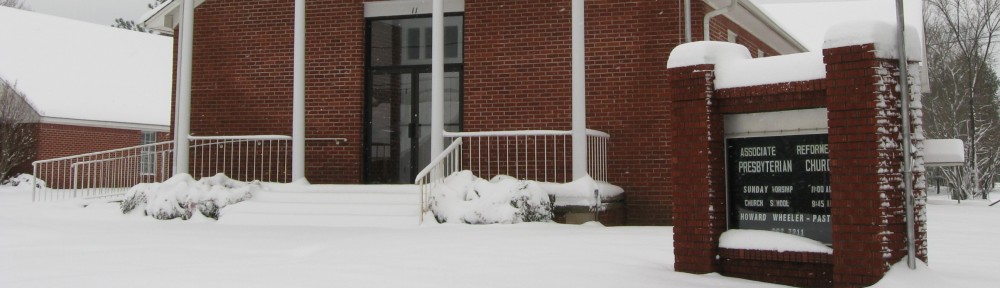
 Pottsville Associate Reformed Presbyterian Church