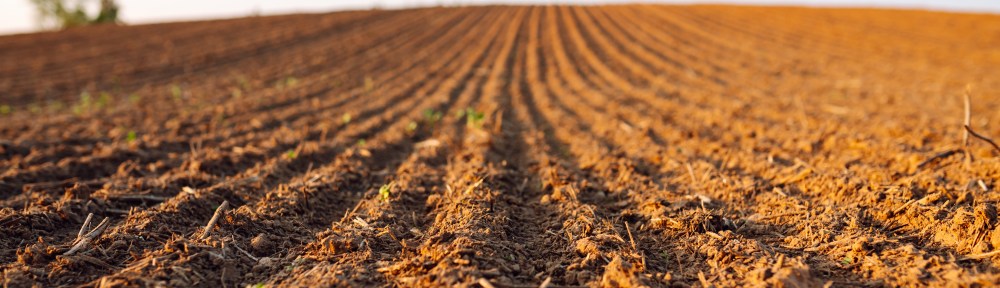
Who is more hopeful than a farmer? If anyone had cause to be pessimistic it is the farmer. A thousand enemies of his hope for a harvest lurk in storm clouds, soaring mercury, invasive tares, broken and breaking equipment, infertile seed or crop land, floods, droughts, pests, broken supply chains, and sheer exhaustion. Old-timers say, “the farmer must plant three times more than he hopes to harvest. A third for the pests, a third for the weather, and a third for himself.” And recently I heard a local farmer comment that “in Arkansas you are always two weeks from a drought.”
Who is more hopeful than the farmer? Who year after year prepares the ground, plants the seeds, attempts to cultivate and irrigate then waits for a process to unfold in the depths of the ground over which he has absolutely no power. It is a mystery to us that a crop ever makes it to harvest. Jesus compared this mystery to the kingdom of God, saying, “The kingdom of God is as if a man should scatter seed on the ground. He sleeps and rises night and day, and the seed sprouts and grows; he knows not how.” Yet the farmer lives by the Scripture that commands “the plowman should plow in hope.”
Yet there is one whose hope is even more radical, more enduring, and more consuming than the farmer. And that is the believer in Jesus Christ. Compared to the adversity faced by the farmer, the condition of a totally depraved man, living in a fallen world with a fallen nature, dead in sins and transgressions seems indisputably hopeless. Like Jesus’ disciples we are tempted to say, “who then can be saved?” And the cry of Paul resonates.
For I know that nothing good dwells in me, that is, in my flesh. For I have the desire to do what is right, but not the ability to carry it out. For I do not do the good I want, but the evil I do not want is what I keep on doing…. Wretched man that I am! Who will deliver me from this body of death?
Romans 7:18-19, 24
Indeed who, or what, can deliver us from our enslavement to sin and misery? From brokenness, sorrow, weariness, fear, and futility? But Paul’s existential question does not go unanswered. The hopeless condition Paul described is followed with an unshakable hope that our sin and misery need not be terminal.
Thanks be to God through Jesus Christ our Lord!.. There is therefore now no condemnation for those who are in Christ Jesus. Romans 7:25-8:1
The Christian is even more hopeful than the farmer because all the promises of God are “Yes and Amen” in Jesus Christ. Promises of forgiveness, redemption, reconciliation, and relationship with our God. Promises accessed through faith in Christ. Promises made and kept by our faithful God.
Nowhere in the Old Testament is the saving work of Christ promised more clearly than in the instructions regarding the Day of Atonement in Leviticus 16. The Westminster Confession of Faith declares that the ceremonial laws “prefigured Christ, His graces, actions, sufferings, and benefits.” And though they are “now abrogated under the New Testament,” Paul reminds us that these were written for our instruction.
Christ is preached in the Old Testament. He himself declared this in John 5:39 when he told the Pharisees, “You search the Scriptures because you think that in them you have eternal life; and it is they that bear witness about me.” Leviticus 16 prefigures Christ, His graces, actions, sufferings, and benefits with remarkable clarity both by way of explanation and contrast. And in Hebrews 9, the inspired author gives us a clear exposition of the work of Christ based on an explanation and contrast with Leviticus 16.
All our hope is rooted in the finished work of Christ as our redeemer. A sufficient and finished work pictured vividly by the Day of Atonement. Are you struggling with hope? Are you drowning in sin and misery, sure there is no hope for you? Has your sin, brokenness, fear, sorrow, or futility plunged you into despair? If so, you need to know that there has been a Day of Atonement. A day on which “for our sake he made him to be sin who knew no sin, so that in him we might become the righteousness of God.” A day on which “a fountain [was] opened… to cleanse them from sin and uncleanness.” A day on which Christ declared, “it is finished.”
Join us as we examine Leviticus 16 and consider the Day of Atonement, why it was needed, what it involved, when it would be fulfilled. We meet on the square in Pottsville, Arkansas right next to historic Potts’ Inn for worship. Get directions here or contact us for more info. Or join us on Facebook Live @PottsvilleARP or YouTube.

